Weird on Purpose: Why A24 Films and Small-Batch Experimental Beers Are the Same Cult Object
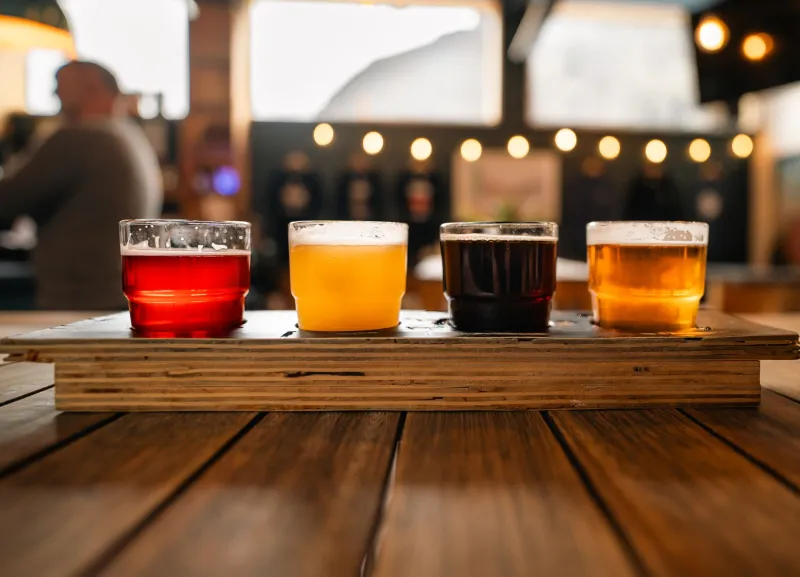
In 2022, a brewery in Portland, Oregon called Culmination Brewing released a farmhouse ale fermented with foraged Douglas fir tips and aged in Pinot Noir barrels. They made about forty cases. It sold out in a weekend. The people who got it talked about it for months. The people who didn't get it talked about it for months, too, but differently.
That same year, Everything Everywhere All at Once won seven Academy Awards after A24 released it into roughly 2,000 screens with minimal mainstream marketing, watched it become a word-of-mouth phenomenon, and then watched the entire internet develop a parasocial relationship with a film about a middle-aged Chinese-American laundromat owner navigating a multiverse of googly eyes and existential dread.
These two things are not coincidences. They are symptoms of the same cultural moment, and if you're the kind of person who cares about both, you are living in a golden age that not enough people are talking about.
The A24 Model, Explained for People Who Also Buy Beer
A24 was founded in 2012 with a fairly simple and completely radical premise: make films that the major studios wouldn't greenlight, trust the filmmakers, spend the marketing budget on weird and memorable campaigns rather than saturation advertising, and build a brand that audiences would follow across projects even when they had no idea what the film was about.
The result is one of the most remarkable runs in American independent film history. Hereditary. Midsommar. Moonlight. Lady Bird. The Witch. Uncut Gems. Men. Past Lives. Civil War. Films that are, by any reasonable metric, extremely different from one another — in genre, in tone, in commercial potential — but that share a family resemblance rooted in creative ambition and a refusal to sand down the difficult edges.
The cult that formed around A24 isn't really about any individual film. It's about trust. When the A24 logo appears, a specific kind of viewer feels a specific kind of anticipatory excitement: I don't know what this is, but I'm in.
Now look at what's happening in American craft brewing.
The Experimental Brewery as Auteur
The parallel is almost embarrassingly clean. A new generation of American craft breweries — places like Monkish Brewing in Torrance, California; Trillium Brewing in Boston; Side Project Brewing in St. Louis; Scratch Brewing in Ava, Illinois — have built devoted followings not by making consistent, predictable flagship beers, but by treating each release as a distinct creative statement.
Scratch Brewing, to use one of the more extreme examples, makes beers entirely from foraged and locally grown ingredients — bark, leaves, mushrooms, herbs — that are almost impossible to categorize within traditional style guidelines. Their releases are small. Their distribution is limited. Their social media following is enormous relative to their production capacity. Sound familiar?
"We're not trying to make the beer that everyone will like," said Marika Josephson, co-founder of Scratch Brewing, in a 2023 interview with Craft Beer & Brewing magazine. "We're trying to make the beer that the right people will love completely."
A24 co-founder Daniel Katz has said, in various forms, almost exactly the same thing about their film slate.
This is not a coincidence. This is a cultural strategy, and it works because of how cult audiences are built.
How Cult Audiences Actually Form
The cult object — whether film or beer — follows a recognizable lifecycle. It emerges from a context of scarcity or obscurity. A small group of people encounter it and have a disproportionate emotional or sensory response. They tell other people with an urgency that feels almost evangelical. The audience grows, but retains the internal mythology of discovery: I was there early. I found this.
Scarcity is not incidental to this process. It's structural. The forty-case run of fir tip farmhouse ale matters partly because of the beer in the bottle and partly because of what it means to have gotten a bottle. The limited theatrical run of Hereditary before it hit streaming matters partly because of the film and partly because of what it meant to have seen it in a theater with an audience that didn't know what was coming.
The experimental brewery and the indie studio are both, at their best, manufacturing meaning alongside their product. They're not just selling a beer or a film. They're selling membership in a community of taste.
Your Field Guide to Finding the Next One
Okay, enough theory. Here's the practical question: how do you actually find these things before they sell out or get buried?
For experimental beer:
- Follow your local bottle shop on social media. The good ones curate aggressively and will announce limited releases with more genuine enthusiasm than any brewery's own marketing.
- Get on mailing lists. Most small experimental breweries run allocation systems for their most coveted releases. The list is free. Sign up.
- Talk to the people behind the bar at your local taproom. Ask what they're excited about right now. This is the single most reliable method, and it also leads to conversations that are genuinely fun.
- Look for breweries that describe their beers in terms of ingredients and process rather than just style. A brewery that tells you their saison was fermented with locally harvested honey and conditioned on dried apricots from a farm forty miles away is a brewery that's thinking like a filmmaker.
For A24-adjacent indie film:
- MUBI is to experimental film what a great bottle shop is to experimental beer: a curated environment where someone with taste has already done significant filtering work for you. A subscription is worth it.
- Follow film programmers at your local indie theater on social media. These people are doing the same work as the good bottle shop — finding things, getting excited, telling people.
- The Letterboxd algorithm, despite being an algorithm, is actually quite good if you feed it honest ratings. Rate everything you watch, including the bad stuff. It learns.
- When an A24 film comes out that confuses the mainstream press, that's usually the signal to pay attention. Confusion from mainstream critics about an A24 release has historically been a strong leading indicator of cult status.
The Pairing, Obviously
So what do you actually drink while watching experimental indie film? A few suggestions earned through experience:
Midsommar — which is, among other things, a film about ritual, community, and the terrifying logic of belonging — pairs remarkably well with a tart farmhouse ale or grisette. Something that tastes like it was made outdoors. Something with a slight unpredictability in every sip.
Everything Everywhere All at Once demands a beer that can hold its own against chaos. A well-made hazy double IPA — something from Monkish or Foam Brewers in Burlington, Vermont — matches the film's density and its unexpected sweetness.
Past Lives, which is quiet and devastating and earns every one of its emotions, wants something clean and lager-forward. A Czech-style pilsner. Something that doesn't compete with the feeling.
The Shared Promise
What A24 and the best experimental breweries are both offering, beneath all the creative risk-taking and limited releases and cult mythology, is a promise: we will not bore you, and we will not condescend to you.
That promise is rare. It's worth seeking out. And when you find it — in a theater showing something you've never heard of, or in a taproom pouring something you can't quite categorize — the right response is the same: get it while you can, pay attention, and tell someone about it.
The next great weird thing is already out there. Someone's already in line.